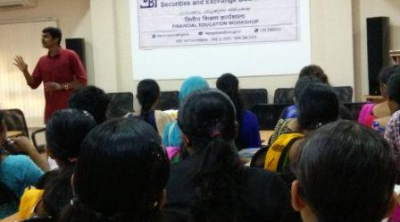
The workshop on financial planning was a programme organized for the Degree and PG students of Microbiology and Biochemistry. There was around 65 students attended the programme. Principal Dr. A. O. Roy inaugurated the function and HOD, Mr. Abdul Bari K. K. did the welcome address and Sachin N. K. delivered the vote of thanks. Mr. Manu, official resource person from SEBI handled the workshop with effective study materials. All the attendants were given with the printed booklet from SEBI in Malayalam detailing all the important aspects of financial planning. Different kinds of accounts and SMART planning for financial management were explained by Mr. Manu in an attractive manner. The students were well engaged with questions and interactions. The session was made memorable with many question answer sets followed by prize distributions. The purpose of this was to provide a basic concept about the financial planning and money management including bank accounts, policies, chities, mutual funds and many other investment options. Altogether this would definitely encourage our students for having a thought before they are going to do a deposit or a money transaction.
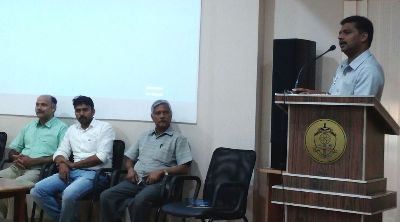
Charles Darwin is a well known evolutionary biologist who wrote the world famous Book on evolution called “Origin of Species”. In connection with his birthday celebrations, Department of Microbiology organized this one day seminar in association with KSSP, Asia’s No 1 science organization with a moto to revolutionize the society with a scientific base. The class was handled by Mr. V. S. Chacko, retired head master and a Biology professor, Nirmalagiri School Kabanigiri and Mr. Tomy, a retired Physics teacher from the same school. The programme was inaugurated by Dr. A. O. Roy, Principal and felicitated by Mr. Shelji Mathew, Professor of Tourism studies. Head of the Department Mr. Abdul Bari welcome the gathering and Mr. Tomy introduced the subject. The session was handled by Mr. V. S. Chacko from 11.30 to 1.30. He stated the facts and principles behind the theory of evolution put forth by Charles Darwin centuries back. The current Indian political scenario was also mentioned by both the speakers and reminded the audience about the importance of revival of society with a scientific, evidence based concepts. Mr. Chacko was eloquent in the subject and he could narrate the situation years back when Darwin started his journey in his Ship to the Galappagos islands followed by the scripting of his book. There was an audience of around 60 from both Microbiology and Biochemistry Department. The students were interactive well in the discussions followed by the class. Many questions related to the theory of evolution were raised by the students and ignited the minds of many.
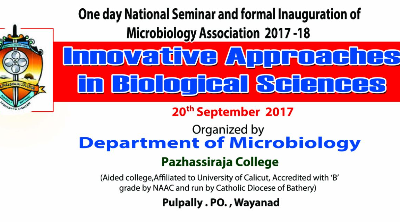
Focus of the Seminar The seminar is intended to discuss the gaps in the academics and diverse industries associated with the area concerned. New thoughts and amenities are inevitable for the success of any research, developments and industrial survival. Here we wish to address the issues in the development of entrepreneurship in the area of biological Sciences and some of the current advances in research and development. The academic endeavor especially in Biological Sciences, is supposed to invoke the innovative thoughts in the minds of young student learners and researchers. The resources imparted must equip them suitable for entrepreneurs and industries or otherwise the exposure should be enough to change the attitude and help them grow as an entrepreneur. The research sectors in Biological sciences are also affected by the change in scenario in the academic interests. The quality of the research scholars is mostly not up to the level demanded. There are ever-changing technological advancements as a result of the most innovative thoughts by the stakeholders, so the one who wish to be a part of the competent world has to be well flourished with thoughts and acts. The issue of pollution is also an ever hot topic of discussion in the development of a sustainable environment. The waste management and disposal is terribly affecting the well being on earth. There are but some hopeful advances in research directed to reduce the harmful effects of pollution in some way. In brief by this seminar we expect a change in attitude, innovations in thoughts and advanced approaches in practices in the area of biological sciences. The Resource Persons 1. Dr. J. Rathinamala, Associate Professor and Head, Department of Microbiology, Nehru Arts and Science College, Coimbatore. 2. Dr. S. Jayashree, Associate Professor, Department of Microbiology, Nehru Arts and Science College, Coimbatore. 3. Dr. Midhila Padman, Assistant Professor, SDM College, Mysore. 4. Mr. Akhil K. Mohan, Research Scholar RGCB, Thiruvanathapuram.
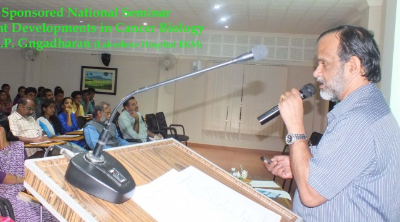
Focal Theme of the Seminar Among various diseases, cancer has become a big threat to human beings globally. As per Indian population census data, the rate of mortality due to cancer in India was high and alarming with about 806000 existing cases by the end of the last century. Cancer is the second most common disease in India responsible for maximum mortality with about 0.3 million deaths per year. This is owing to the poor availability of prevention, diagnosis and treatment of the disease. All types of cancers have been reported in Indian population including the cancers of skin, lungs, breast, rectum, stomach, prostate, liver, cervix, esophagus, bladder, blood, mouth etc. The causes of such high incidence rates of these cancers may be both internal (genetic, mutations, hormonal, poor immune conditions) and external or environmental factors (food habits, industrialization, over growth of population etc.). Knowledge of the warning signals of cancer helps one to get an early diagnosis and a successful treatment. In a shocking revelation, Kerala Chief Minister Oommen Chandy informed that the state has the highest number of cancer patients in the country. Out of every one lakh males, 133 persons suffer from the disease while in the case of females, it is 123 for every one lakh females. As per statistics, nearly 50 per cent of cancer cases could be cured if the disease was identified in the initial stage itself and treatment started. The number of cancer patients in Kerala has registered an alarming increase of over 200 per cent in the last three decades. As per the figures released by the 'Hospital Based Cancer Registry' (HBCR) of Regional Cancer Centre here, a premier hospital which handles more than one third of cancer cases in the state, 2,49,362 patients visited RCC seeking treatment in the last 30 years. According to the HBCR data, breast and thyroid cancer are found to have been more prevalent among women. Though the cancer of uterine cervix has declined in the last 30 years, the number of breast cancer cases has shot up alarmingly, especially among youngsters. A total of 28.1 per cent of all cancer cases reported among women in the hospital were breast cancer. Oral cancer continued to be more predominant among men than other forms of cancer like those affecting prostate, rectum and thyroid. A striking trend that happened over the years is the increase of leukemia cases among both men and women. Cancer is spreading like anything in Wayanad district. In 2004, there were only three pain and palliative clinics in the district, which increased to 25 this year. Going by the data of the Pain and Palliative Movement, its volunteers cater to 2,500-odd patients; mostly cancer patients. The number of patients who are undergoing treatment for cancer would be much higher than patients at the final stage. The number of cancer patients among the tribal population is also increasing. In view of these facts the Department of Lifesciences, Pazhassiraja College, Pulppally is organizing a three days national seminar on “Recent Developments in Cancer Biology” to provide a platform to discuss about the attempts that have been made to study the status of cancers in India including its causes, preventive measures, effect on Indian economy and comparison with global scenario.
Science for nation building is the theme for the celebrations of national science day 2015. Since the independence the country achieved lots of milestone development in multidimensional sectors for the development of the nation. Agriculture is of prime concern for all the periods and technological support has been given by the scientists and researchers. The central and state governments are well aware of the scenario and have made policies relevant to fulfill the dreams our great persons in the fields of science and technology. The theme for the current year well appreciates the efforts of the government for the motivation in the field for nation building Programme Schedule 25 February, 2015 9-10 am : Registration 10-10.45 am : Inaugural session (Chitrasala Auditorium) Dr. Varughese K. John (Principal, Pazhassiraja College) Fr. Thomas Mannithottathil (Bursar, Pazhassiraja College) Dr. K.P. Saju (IQAC Coordinator) Prof. Rajagopalan (Staff scretaary) 10.45-11.00 am: Tea break 11.00-1.00 pm : Session 1-Invited lecture Dr. Deepu Mathew Asst Professor Centre for Plant Biotechnology and Molecular biology College of Horticulture Kerala Agricultural University 1.00-2 pm : Lunch break 2.00-4.00 pm : Session 2-Invited lecture Dr. P.R. Manish Kumar Associate professor Cell & Molecular biology/Recombinat DNA technology Laboratory Dept. of Biotechnology University of Calicut 26& 27 February 2015 (Central Instrumentation laboratory) Demostration on Basic Molecular biology techniques.
Resource persons Dr. UC Abdul Jaleel (IISc, Bangalore) Dr. Murugesh Easwaran (Bharathiar University) Mr. Murugan N (L& T Microbiology research centre, Chennai) Mr. Sinosh Skariyachan (DS College, Bangalore)
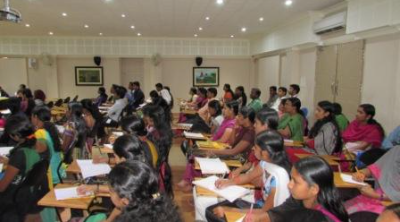
The programme conducted on 25th November as per schedule. All the arrangements were done in the auditorium (Chitrasala) of Pazhassiraja College, Pulpally. The registration started by 9 am and the technical sessions by 10 am. The talk on Crystallography was delivered by Dr. K.S. Pramod, Asst Professor, St. Marys College, Sulthan Bathery and the awareness talk on Science education and Research by Mr. Aneesh George, Research Scholar, Kerala University. The Quiz programme was moderated by Mr. Aneesh George. Refreshment was given to all the participants and deligates. A total of around 100 participants attended of which 18 were from various Higher secondary schools, 45 students from college and 20 faculty members from schools and colleges.
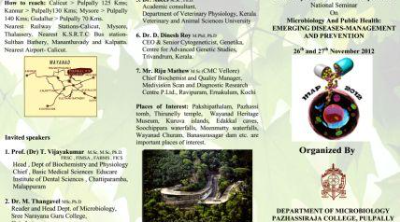
The Department of Microbiology conducted a National Seminar on the special theme “Microbiology and Public Health: Emerging Diseases-Prevention and Management” on 26th and 27th of November 2012. An organizing Committee was postulated chaired by the Principal and Convened by the Head of Microbiology Department for the smooth conduct of the programme. The Seminar was held at Chithrasala (Audio Visual Theatre), Pazhassiraja College, Pulpally, Wayanad. It was a two day programme consisted of seven theme sessions and two technical sessions. More than 150 delegates from various institutions in and around Kerala were actively participated in various sessions. A total of fourteen papers were presented by scientists, professors, academicians and research scholars covering the focal theme. The National Seminar was sponsored by University Grants Commission, New Delhi. The order/file No. is SEM-1310/10-11/KLCA001/UGC-SWRO dated 17-March-2011. An amount of 125000(One lakh Twenty five Thousand Rupees) were allocated by UGC under various items of expenditure, of which 93750 (Ninety Three Thousand Three Hundred and Fifty Rupees) were released. We have incurred a total Expenditure of 145196 (One lakh Fourty Five Thousand One Hundred and Ninety Six Rupees) under various items allocated by UGC. The audited statement of expenditure and Utilization Certificate have submitted for final approval by UGC.